This is factually incorrect on two grounds: First, the adoption of Chip & Pin in Europe predates the European Union. Second, credit card fraud in Europe, France in particular, was out of control before its adoption. I believe it was either a French or Swiss researcher that developed the technology in response.
My understanding is that French (and presumably other European) banks assigned the liability for fraud to the account holder, whereas in the US, liability for fraudulent credit card charges falls to the banks and the credit card processing networks.
This meant that individual account holders were much more tolerant of chip-and-pin technology, and demanded additional security features like portable card readers, which mean that the credit card never leaves the account holder's possession.
Do you have a source for this? Lite googling suggests this isn't true now in the UK (e.g., http://www.theukcardsassociation.org.uk/faqs/ ) and I can't find any evidence it was true in the past.
This is mostly false. In the past, the liability was completely on the bank. In October, it switched to the merchant only if the merchant hadn't upgraded to a chip reader. The switchover process is continuing, and when it is complete the liability will be with the banks, as it was before.
It's been a while, but I seem to recall in a past company that for card-not-present transactions, the risk of fraud was on us, not on the bank approving the transaction.
Chip and pin does not predate the EU. Debit cards used to be swipe and pin since the 80's, credit cards were not so widely used and supported both pin and signature.
I don't doubt that that many complicated economic and political factors influenced things, but you're interpreting the fraud data wrong. The US credit card fraud rate as a fraction of transactions value is currently only double (~2.1 times) the EU rate, and only 1.5 times the UK rate:
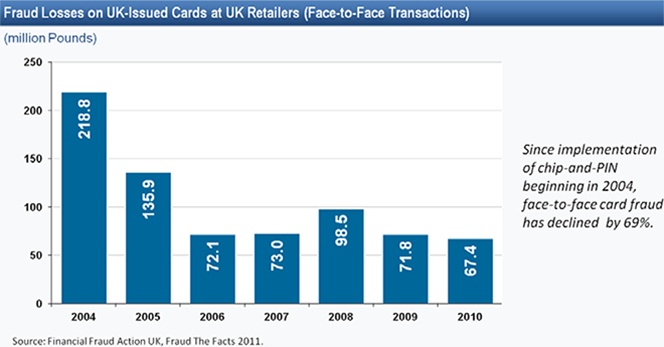
I am unable to find good data on fraud rates in Europe going back before chip-and-pin, but the system reduced fraud in the UK by ~60-70%, at least for face-to-face transactions:
So the UK almost certainly had significantly higher fraud than the US before rolling out chip-and-pin. If
seliopou is right, then this was also true for France.
Let me know if you can find better Europe-wide data.
Interchange fees are set based (in large part) on how much fraud the processor expects to deal with. This is why interchange fees are lower for card-present than card-not-present transactions, and higher in business categories that tend to have more fraud.
A processor does not charge lower fees for chip cards in a vacuum, they do it because they expect to eat less fraud from chip cards.
Oh, I understand what you're claiming now. But I don't think the effect your describing is very important. As colechristensen points out, the fees in the US are 5-20 times larger while their fraud rate is only about twice. So it looks like other factors (e.g. degree of regulation, monopsony effects, etc.) have a much larger influence on interchange fees than fraud rates. Indeed, the amount lost from fraud is only about 0.1% of transactions in the US, and 0.05% in the EU.